
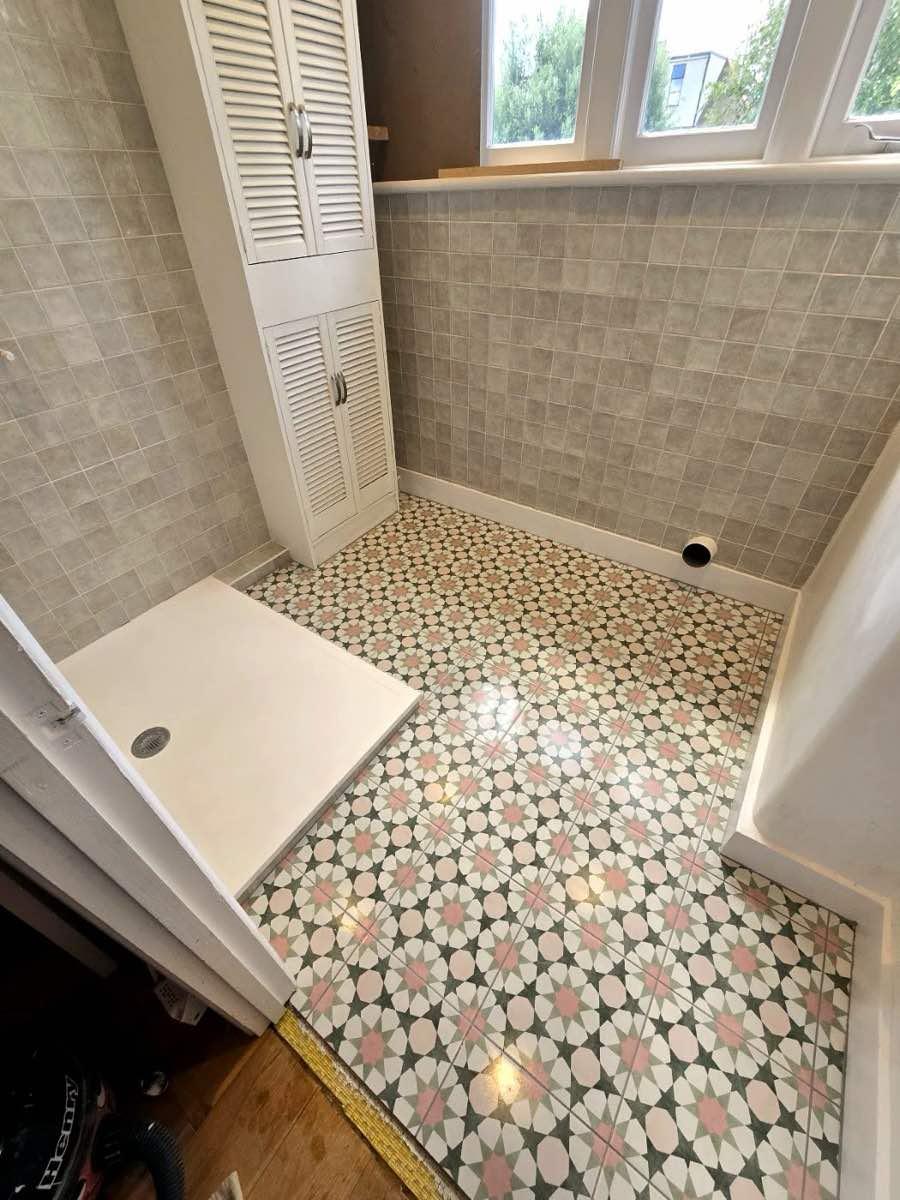
Tile and stone are among the best floor finishes for underfloor heating. They conduct heat well, they do not mind being warm, and a heated tiled floor in a bathroom or kitchen is hard to go back from.
They do need the floor building up in the right order, though. Heat makes a floor expand and contract, and if the base, adhesive and tile are not chosen with that in mind, the grout cracks and tiles can debond. Here is how it should be done.
Electric mats and water systems
There are two main types of underfloor heating, and they go in differently.
- Electric systems are thin heating cables or mats laid on the subfloor, often over an insulation board. They are popular in bathrooms and smaller rooms and in refits, because the build-up is shallow.
- Water systems, sometimes called wet systems, run warm water through pipes, usually set in a screed. They are more common in new builds, extensions and larger open-plan rooms.
With electric mats, the cables are usually covered with a thin layer of levelling compound before tiling, so the tiles sit flat and the trowel cannot damage the cable. With a screed, the screed itself is the base for the tiles.
The electrical side
Connecting electric underfloor heating, particularly in a bathroom or where a new circuit is needed, is electrical work that can be notifiable under Part P of the Building Regulations in England. It should be done by a qualified, registered electrician, who can test the mat before and after tiling and certify the work.
Testing the mat before it is covered and again afterwards matters. If a cable has been damaged during installation, you want to know before it is under tiles.
Screeds need to dry, and the heating needs commissioning
With a water system in a screed, the screed has to be dry before tiling, and drying takes time. Calcium sulphate screeds, often called anhydrite screeds, are common with underfloor heating. They need the surface laitance removing, the right primer, and they react with standard cement-based adhesives unless the correct primer or a suitable adhesive is used.
Before any tiles go down, the heating should be commissioned. That means bringing it up to temperature slowly, holding it there, then bringing it back down slowly, following the screed and system manufacturers' instructions. This drives out moisture and lets the screed do its initial moving and any cracking before it is tiled, not after.
Adhesive, grout and decoupling mats
The adhesive needs to be a flexible one, rated for heated floors, with full coverage under each tile so there are no voids. Hollow spots over a heated floor are where tiles crack. Flexible grout is used for the same reason.
A decoupling membrane is often laid between the base and the tiles, especially over screeds, timber floors and with natural stone. It lets the base move slightly without passing that movement into the tiles. Movement joints at the edges of the room, at doorways and across large areas are also part of a heated floor, and should not be grouted over.
Timber floors with underfloor heating
On a timber floor, the floor must be stiff before anything goes on it. Boards are usually overboarded with tile backer board or a suitable ply, screwed down at close centres, and then the heating, levelling compound, decoupling layer if used, and tiles follow. A floor that flexes will crack grout whether it is heated or not. I cover this in more detail on my floor tiling page.
When can you switch it on?
Once the tiles are down, the heating should stay off until the adhesive and grout have properly cured. Guidance from adhesive makers is commonly at least a week, and some say longer, so check the products used. Then bring it up gradually rather than straight to full temperature.
It is tempting to test it straight away, especially in winter. It is worth waiting.
Choosing tiles for a heated floor
Porcelain and natural stone both work well over underfloor heating. Thinner tiles heat up a little faster. Large format tiles can be used, but the floor needs to be very flat, and the extra movement of a heated floor makes the adhesive choice and decoupling more important. For more on the tile itself, see porcelain or ceramic tiles.
I tile over electric and water underfloor heating across Chelmsford, Springfield and Danbury, working alongside your electrician or heating engineer. See floor tiling, preparation and waterproofing and bathroom tiling, and read how long it takes to tile a bathroom. For a free quote, get in touch or call 07792 959839.
Published by Aarron, Ceramic And Marble Tiling