
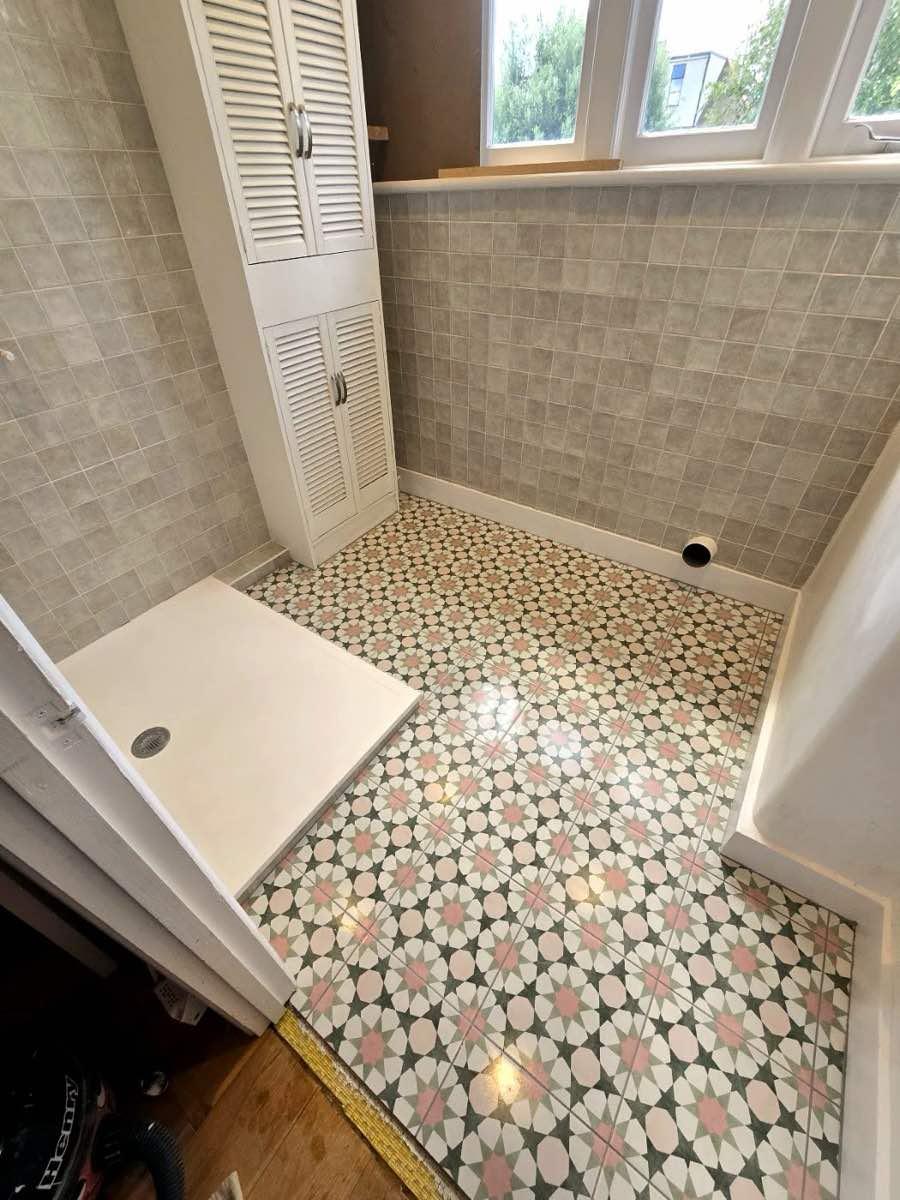
Grout gets less thought than the tiles, but it changes the look of a room more than most people expect. The same tile with white grout and with charcoal grout can look like two completely different floors.
Here is how to choose the colour, which type of grout suits which job, and how to keep it looking clean.
Matching, toning or contrasting
- Matching grout, close to the tile colour, makes the surface read as one. It suits large format tiles, stone effects and rooms where you want a calm, seamless look.
- Toning grout, a shade lighter or darker, softens the grid without hiding it.
- Contrasting grout, such as dark grout with white metro tiles, makes the pattern the feature. It suits herringbone, hexagon and other shaped tiles.
Contrast also shows any irregularity in the tiling, so it needs very consistent joints. I'll show you a sample on the actual tile before grouting, because grout looks different on the wall than on a colour chart.
Practical colour choices
Bright white grout on a floor or behind a hob will discolour over time, however carefully it is cleaned. Mid greys and warm greys hide dirt and wear far better on floors and splashbacks.
In a hard water area like Chelmsford, very dark grout in a shower can show white limescale marks. A mid tone, or a regular wipe-down, helps.
Cement-based grout
Most domestic tiling uses cement-based grout. Modern ones are much better than old grout: many are flexible, water resistant and mould resistant, and they come in a huge range of colours. They are easy to work with and, if needed, can be raked out and replaced later.
Flexible grouts are used on floors with underfloor heating, on timber bases and anywhere with a bit of movement.
Epoxy grout
Epoxy grout is a two-part resin rather than a cement. It is much more resistant to staining and water, which makes it popular in showers, wet rooms and behind kitchen worktops. It is harder to apply, sets faster, and costs more, and it needs care so the residue does not cure on the tile face.
It is worth considering where staining or water is a real concern. For most walls, a good cement-based grout is fine.
Joint widths
The width of the joint depends on the tile. Rectified tiles, which are machined to precise sizes, can take narrow joints. Non-rectified and handmade tiles vary in size and need wider joints to absorb that variation. Very narrow joints on uneven tiles show every difference.
The tile manufacturer will usually give a minimum joint width. Grout is also part of what lets the tiled surface accommodate small movements, so joints should not be made unrealistically narrow.
Grout is not waterproofing
Even the best grout is not a substitute for tanking in a shower. Water still gets through in small amounts, and the waterproofing behind the tiles is what deals with it. What is a wet room and signs your shower is leaking explain why.
Corners, the joint between walls and floor, and the joint around a bath or tray should be finished with silicone, not grout, because those joints move.
Keeping grout clean
- Squeegee or wipe shower walls after use.
- Clean with a mild, pH-neutral cleaner. Harsh acids and bleach can wear grout over time.
- Use a soft brush on floor grout every so often.
- Consider a grout sealer on cement-based grout in kitchens and showers.
- Replace silicone when it discolours or lifts, rather than cleaning it endlessly.
With natural stone, use only stone-safe products. Caring for marble and stone has more on that.
I help with grout choice on every job I tile across Chelmsford, Great Baddow and South Woodham Ferrers. See wall tiling, floor tiling and bathroom tiling, then get in touch or call 07792 959839 for a free quote.
Published by Aarron, Ceramic And Marble Tiling