
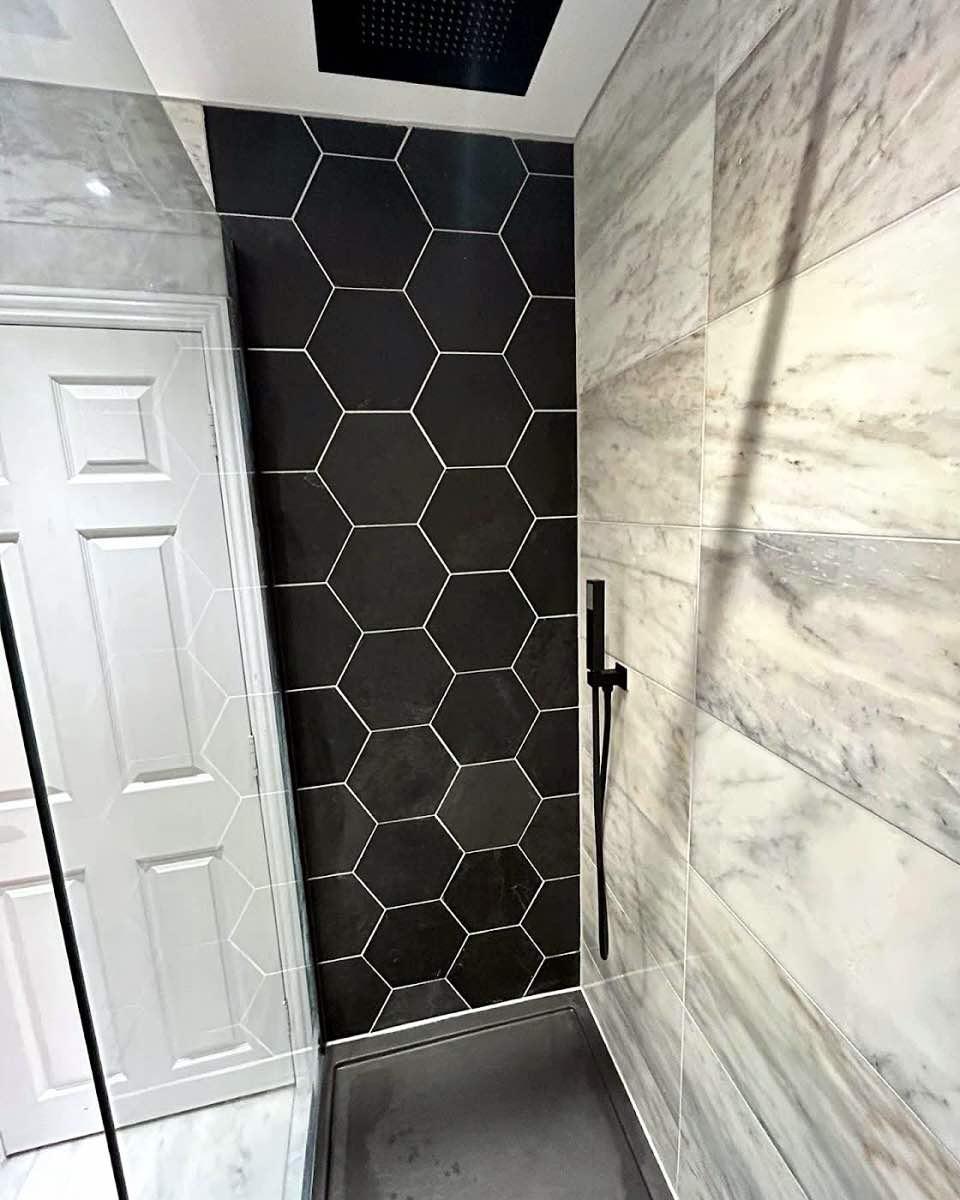
A tiled splashback protects the wall behind the worktop and is often the main feature in a kitchen. It is also one of the most visible bits of tiling in the house, because you stand in front of it every day.
Here is what to think about before you choose tiles, so the finished splashback looks planned rather than squeezed in.
How high to tile
There is no single right height, but there are a few common options.
- A short upstand, a row or two above the worktop. Practical, but can look unfinished with tall wall cupboards.
- Worktop to the underside of the wall units. The most common choice, and it makes the kitchen look finished.
- Full height behind the hob or sink, often up to the extractor or the ceiling, as a feature.
- Floor to ceiling on a wall without units, for a bolder look.
Where there are no wall units, choose a clear stopping line, such as a set number of rows or the top of the window, so the edge looks deliberate.
Behind the hob
The wall behind a hob takes heat and splashes, so it needs a suitable surface. Ceramic and porcelain tiles are both fine there. Check the hob and extractor manufacturer's instructions for any minimum clearances, particularly behind a gas hob. A hob is often where people choose a feature tile, so that is also where the setting out matters most. I usually centre the pattern on the hob or the extractor so it looks balanced.
Sockets, switches and worktops
Splashbacks are full of interruptions. Sockets and switches should be cut neatly so the faceplate sits flat on the tile rather than covering a ragged edge. With thicker tiles, sockets may need bringing forward so the plate sits flush, which is a job for an electrician.
Tiles should be scribed tight to the worktop and finished with a neat silicone joint, not a wide bead covering a poor cut. Window reveals, the end of the worktop and the edges of wall units all need deciding before the first tile goes on, because they decide where the cuts fall.
Choosing the tile
Almost any wall tile works on a splashback, which is why it is such a popular place for a feature.
- Metro tiles in gloss ceramic are a classic choice, and the layout, straight or herringbone, changes the look completely.
- Large format porcelain gives a near-seamless look with few grout lines, which is easy to wipe down.
- Zellige-style and handmade-look tiles vary tile to tile, which is part of the appeal, but they need more time to lay.
- Natural stone looks wonderful but needs sealing and stone-safe cleaners, as cooking oils and acidic splashes can mark it.
Gloss tiles bounce light around, which helps in darker kitchens. Matt tiles hide water marks better in a hard water area.
Grout and edges
Grout behind a hob and sink gets dirty quickly. A mid-grey or a colour close to the tile hides marks far better than bright white. Some grouts are made to resist staining, which is worth considering behind a hob, and epoxy grout resists stains better still, though it is harder to apply.
Exposed edges need finishing with a trim, or with tiles that have a finished edge. Trims come in metal and plastic, in a range of colours, and should be chosen with the tile rather than as an afterthought.
Tiling over an old splashback
If the old splashback tiles are sound, flat and well bonded, tiling over them can work, because a splashback is dry and lightly loaded. The extra thickness affects sockets and the worktop joint, though, so measure first. Can you tile over tile covers the checks.
I tile kitchen splashbacks and full kitchen walls across Chelmsford, Writtle and Danbury. See kitchen tiling and splashbacks, wall tiling and floor tiling, and if the floor is next, porcelain or ceramic tiles is worth a read. Get in touch or call 07792 959839 for a free quote.
Published by Aarron, Ceramic And Marble Tiling