
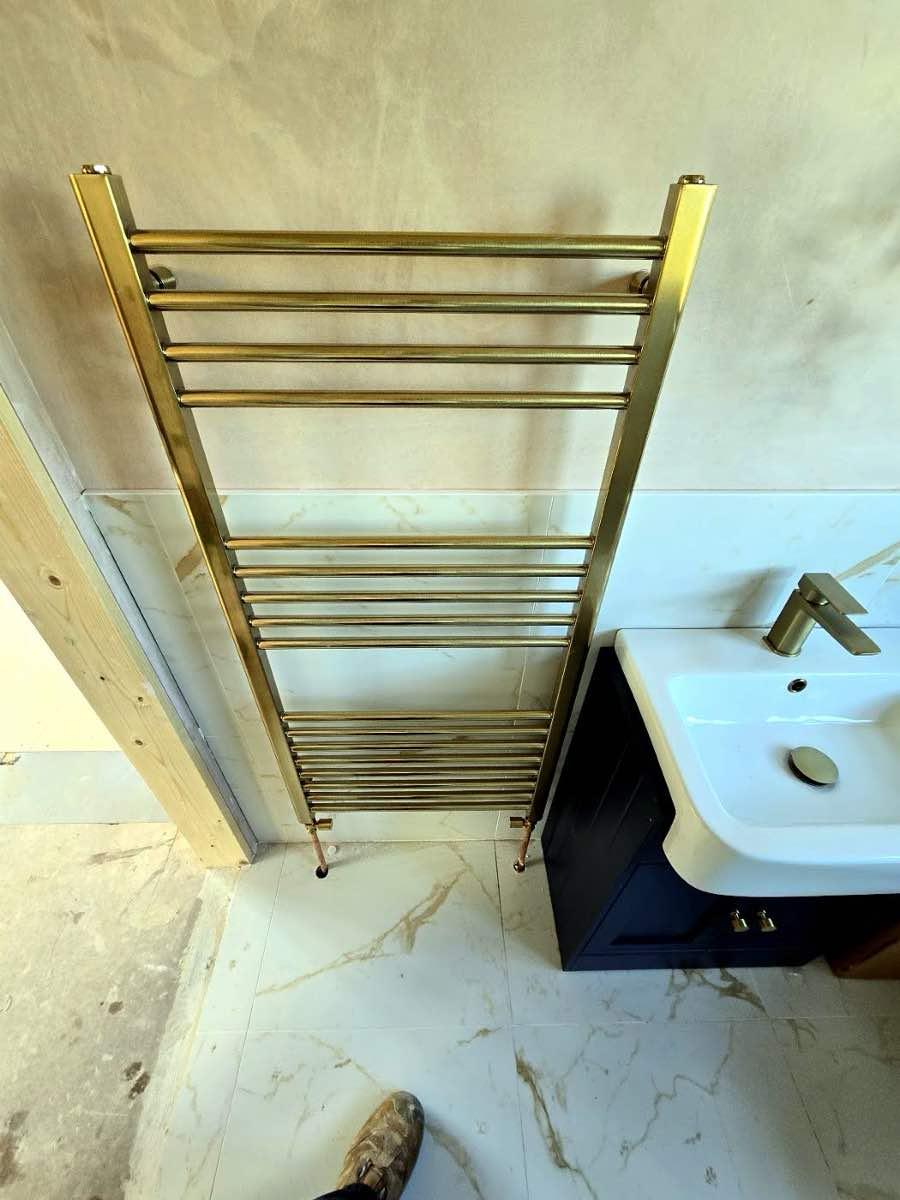
Large format tiles, generally anything with a side of 60 cm or more, are one of the most common requests I get. Fewer grout lines make a room look bigger and cleaner, and big porcelain slabs on a kitchen floor or a shower wall look very smart.
They are also the least forgiving tiles to fit. Here is what they need to look right, and what to check before you buy.
Why big tiles need a flatter base
A small tile follows the surface beneath it. A large tile spans it. Any dip or hump in the floor or wall either leaves a void under the tile or pushes one edge higher than its neighbour. On a 30 cm tile you may not notice. On a 120 cm tile you will see it, and feel it underfoot.
That is why floors for large format tiles are usually levelled with a compound first, and walls are checked with a long straight edge and boarded or made good where they are out. Hoping the adhesive will take up the difference is how lipping and hollow tiles happen.
What lipping is, and why it happens
Lipping is when the edge of one tile sits higher than the next. Under a low window or a spotlight it casts a shadow along the joint, and on a floor you can catch it with your toe. The main causes are:
- An uneven base, as above.
- The natural slight bow found in many long tiles, which is within manufacturing tolerances but shows when two tiles meet at their centres.
- Patchy adhesive coverage, so tiles can sink or rock.
Levelling clip systems help hold edges flush while the adhesive sets, but they cannot fix a bad base.
Layouts: watch the offset
Long rectangular tiles laid in a half bond, where each row is offset by half a tile, put the highest point of one tile's bow next to the lowest point of its neighbour. Many manufacturers recommend an offset of no more than a third of the tile length for that reason. Always check the box or the technical sheet.
A straight stack or a third offset generally gives a better result with long tiles. I'll set out the floor or wall so the full tiles run where you look and the cuts fall at the edges, which matters more with big tiles because there are fewer of them.
Adhesive and coverage
Large tiles need a high-performance flexible adhesive, often a rapid-set one, with full coverage under the whole tile. That usually means a larger notched trowel and buttering the back of the tile as well as the floor. A void under the middle of a large tile is a weak point, and it is often where a crack starts if something heavy is dropped.
Large tiles on walls
Walls have weight limits. Plaster and plasterboard can only carry so much, and the adhesive and grout count towards the total. Large porcelain, especially thicker tiles, can go over those limits. In that case the wall is boarded with a tile backer board designed to take the load, fixed to the studs or the wall behind.
Large tiles on walls also need support while the adhesive sets, and a flat wall is just as important as on a floor. For more on wall weight limits, see can you tile over tile.
Handling and access
Very large tiles are heavy and can snap if lifted wrongly. They need two people, and sometimes specialist carrying frames and cutting rails. Check that tiles will physically fit up the stairs and round the corners to the room they are going in, and that there is somewhere flat to store them.
Large format in wet rooms
Large tiles cannot bend to follow a floor that falls in four directions to a centre drain. If you want large tiles on a wet room floor, a linear drain with a single fall is usually the better design. What is a wet room explains the difference.
I fit large format porcelain on floors and walls across Chelmsford, Springfield and Danbury, including on new builds and developments. See floor tiling, wall tiling and preparation and waterproofing, then ask for a free quote or call 07792 959839.
Published by Aarron, Ceramic And Marble Tiling